postscripts on electropop² (have a happy christmas)
Dec 25, 2025
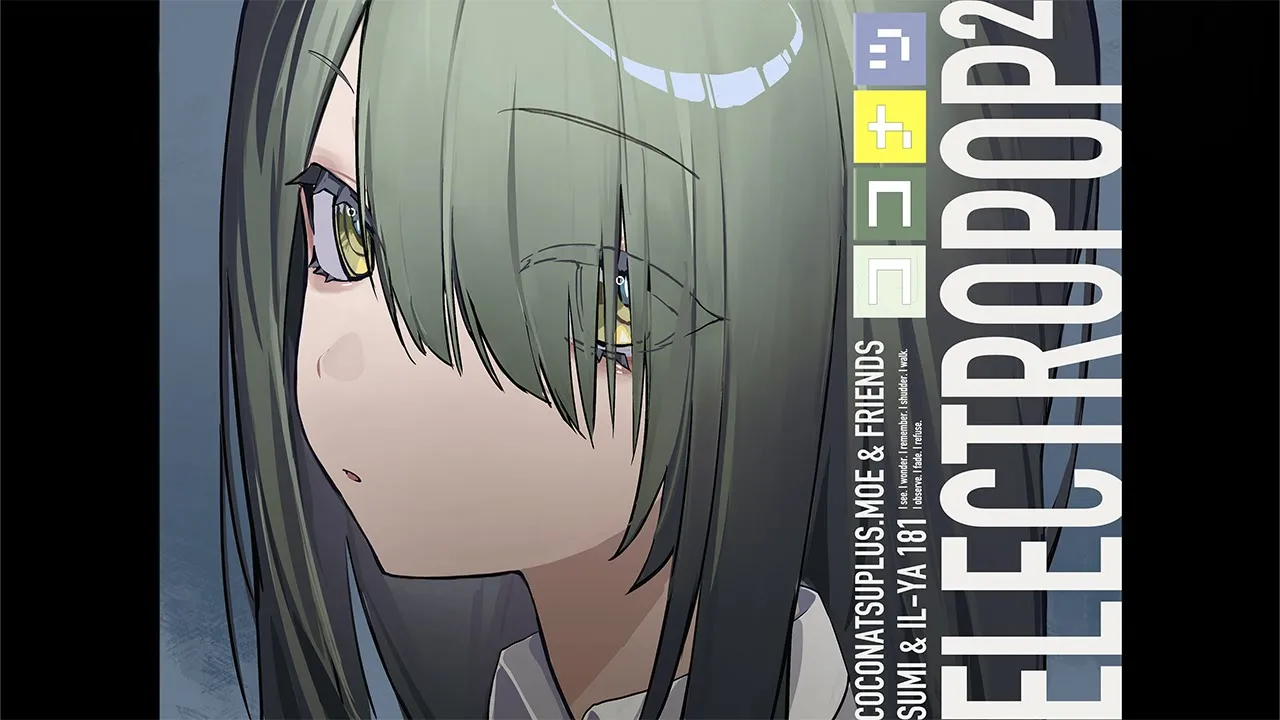
Well, this is it, the final video in my denpavlogging journey. It was short lived, I don’t actually have much to say, and if I do have something I want to say, I feel like I should know far more about it before I try. The release of this video is also the end of a particular brand of writing I partake in. I’ve grown tired of my meandering prose; writing in circles, about unclear theses to the payoff of no one, failing both in the discovery of concepts and in the realm of affective perception. Although, change cannot be foregrounded merely through the use of language. This video as well as the previous essay were drafted with the intention of signaling a coming transformation, for my own purpose, to reorient where I believe I ought to, and for those who visit this website, to pay respects to people who give me the time of day. Maybe you can learn along the way too.
Do people even call it a denpavlog?

https://x.com/ashamutoki
The denpavlog can be described as a return to early YouTube. Early YouTube, much like many unforeseen markets (unrealized until the advent of the accomplice program) had to carve out a specific niche to keep afloat. This was done by reconfiguring older forms of entertainment to fit these new uninstantiated standards, and would eventually give rise to the new styles that would forcibly claim those positions left by the reconfigured elements. This would then lead to what the platform is known for: skits, music videos and vlogs. Skits are more generally accessible when compared to its retro counterparts on the television. Compare the WKUK to the likes of Smosh, and they share many formulas, if only differentiated by levels of capital and Smosh's humor tailored for internet netizens. Music videos, once widely available on MTV, are now available on-demand through Vevo on YouTube. This leaves vlogs, but they can't be correlated directly to older forms of video entertainment, except maybe through "live television" or Josh Harris' early dot com antics; they are explicitly part of the "new media".
The vlog is unique to the digital age format. It's both personal confession, anecdotal rant, and selfhood-by-proxy-of-content all at the same time. Vlogs are analogous to the "live stream" if only because they "convey the immense affective power of webcam usage", and further extrapolated by Ken Hillis, "at times these encounters induce feelings of absence and 'wish you were here,' yet mostly they have the opposite effect: everyone feels that they are somewhat in each other's presence."
This new form of confessional content lays out a new framework for viewers and creators to play around with. These formats are affective precisely in how 'open' they present themselves to be, substituting a presence of another person, establishing parasocial connections with viewers and creators alike. You come to learn about someone, whether or not the entire identity is performed (referred to as a 'bit') or where the identity and performance comingle so deeply that a split is categorically impossible. The distinction becomes increasingly banal to make, but the denpavlog is after something of another nature.
The denpavlog is not a normal vlog, what separates the "if you keep carrying old bricks, you'll build the same house.” from “nightcore” are different problems from different spheres of sociality. Both are vlogs in the same sense, but are presented by people of unique status, monetarily, culturally, and in their contextualization of personal experience. The denpavlog cannot arrive through a reduction of form, that is, in its placement among other works, differentiated by a unique presence, but through its counterpoints to a mainstream. Denpavlogging in this way garners audiences fitting for this task, and presents a different language of self-analysis by proxy of video recording. You are invited less to reconsider how you live your life (self-help) and more towards learning about a stranger and their worries, to play deeper into affective resonance with a perceived "outsider" likely similar to the viewer.
Denpavlogging as a practice functions similarly to talking to a friend, replaced by a microphone or camera, about something you’ve been thinking about. Electropop and coco nights are my videos, uneducated speeches in the dark, floating and colliding with various thoughts in a delirium of all the things your mother warned you about, neurosis, an almost essential characteristic to this identity laden style.
Neuromantic (Japanese: ニウロマンティック)
The ultimate point of contingency for the genre and all subsequent offshoots is the coddling of socially off-kilter beliefs and thought processes. Negating normativity isn't inherently negative, but the denpavlog format constructs personality traits that transmogrify neuroticism into identity. If I were to impose a sort of political agenda here: stasis is largely unproductive, we are better off reducing neuroticism to a point where it no longer provides a sense of identity from its vice signalling.
The personal branding, surely a retrograde concept, returns to the viewers as a capturing apparatus, no matter what monoliths it aims to construct.

The denpavlog format demonstrates this dynamic concretely with Trixie The Golden Witch’s original moniker, Digibro. The “after dark” era is the same time Digibro’s view counts went up, where the majority of her videos had thousands upon thousands of views, to the extent that people would come watch her rant about anything, and ironically “parasocial relationships”. Around the same time, a video titled “Insomnia Analysis” would crystalize the denpavlog form, as well as the ethos surrounding it. Within the method of expression, statements made as personal confession became inseparable from identity, leading to public breakdowns, erratic political positions, and eventual disavowal of the entire persona, playing a game of authenticity with yourself and the content you provide. Sprouting from this, a small set of independent vloggers seemed to continue the style of content that was left behind.
There’s a tight thread running between minor styles of expression. Jonathan E. Abel comments on his review of Galbraith’s book on Otaku Imagination, “There is a zero-sum system to this imagination described by the book as "alternative" social worlds that are relative to and dependent on the existence of a mainstream.”
This extends deeper into many types of culture, cartographies of style, and even in the mode of personal expression. The zero-sum system described here is a critique of a methodology of the otaku that fetishizes the transgressive nature of some of the works within their sphere. This system requires an “outsider” group to derive the pleasure of their identity. This is seen as unproductive and irresponsible on the side of Galbraith for not confronting this viewpoint in his book at large.
Denpavlogging’s standard approach relies heavily on the sense of a similarly transgressive negation of the mainstream. NEETs, isolation, alternative lifestyles, a standard of zaniness, all signal to the viewer that they are either “your guy” or “not your guy”. These traits themselves are not inherently irresponsible or merely reproducing the hegemonic conditions they claim to oppose, but they can be places where neuroticism finds place to bloom. Alienation can be productive. Neuroticism, reified into identity, is not. The respite lies in depersonalization.
Production & Play & Performance
This video was constructed by writing what came to mind at certain occasions of the day, edited numerous times to cohesively mesh a centre thesis, and eventually thrown together with the rough outline I believed to have created. Originally, the script was 17k words, then eventually brought down to about 7k to make sure the runtime stays below a certain point. Circling the same points should not be a byproduct of self flagellation, but instead be regarded as a center form explicitly recognized and oriented around.
“Electropop²” is representative of things I find inspiration in, channeled through a fine sieve of amateur editing and a flippant sense of direction/aesthetics. To take notes from the original style set out by people such as Digibro, Artificalnightsky, Osaka Syndrome, and N0THANKY0U, I take the formula of the unfocused rant and push towards something more fitting of my current sensibilities. Each segment is slightly different in tone, pushing further and further away from a neurotic self-analysis as seen in the first segment, and eventually dismantled during the final efforted performance within the mock breadtube video essayist persona.
Heavy narration, especially from the perspective of the author, is uncharming. The only thing I wish to say is this: the video functions as a terminal performance of content creation within the format itself, documenting its inadequacy while announcing my departure from that position. The more explicit notes are about a gap between two (seemingly) separate subject positions, between a “haunted” otaku, and a “machinic” otaku. This is elaborated in the Otakumaxxing manifesto.
Theory and philosophy appear throughout the script frequently. They are both indispensable in constituting a wariness to each topic in the video, and for affective narration. Within writing the script, they activate a compulsion to elaborate and verify understanding, a process I employ regularly in day to day life (to the dismay of others).
I'll Try Living Like This
wait till christmas!
This video isn’t a denpavlog in a traditional sense. I tend to refuse a direct (as in, made explicit) confrontation with my own anecdotes. Personal history is channeled through mediation, isolation, distance, and theory turned in towards the person. The production exceeds typical denpavlog aesthetics while maintaining canonical elements: personal reference, subcultural markers, aimless self-conversing. The stark contrast in my original videos to this one is intentional, because this really will be the last time.
Moving forward, I hope you stick around. Take care.
Comments
